Annual Reports
Salesforce, Inc.'s annual reports contain management's most considered account of the business. These are the sections, passages and visual pages worth opening in the originals preserved in Sources.
Salesforce, Inc. — FY2026 Annual Report (Form 10-K, fiscal year ended January 31, 2026) — FY2026
Latest 10-K: reframes Salesforce as an AI 'agentic enterprise' platform and renames the entire revenue taxonomy around Agentforce. · Open the full document →
Item 1. Business — Overview and Service Offerings — p. 6 · Read the full section →
Management's own description of what the company is and the AI-agent products it sells.
Overview: from 'CRM leader' to the platform helping organizations become 'agentic enterprises.'
Salesforce, Inc. (“Salesforce,” the “Company,” “we” or “our”) is a global leader in customer relationship management (“CRM”) technology, helping organizations of any size become agentic enterprises. Founded in 1999, we bring humans, agents, applications, and data together on a trusted, unified platform to unlock growth and innovation.
p. 6 · Read in context →
The core offerings — Agentforce Sales, Service, and the 360 Platform — all built around AI agents.
Agentforce Sales. Our Agentforce Sales offering is an integrated platform that brings together the power of humans with AI agents to help sales teams sell faster and smarter, and to efficiently manage and automate entire sales processes. […] Agentforce Service. Our Agentforce Service offering enables companies in every industry to bring all of their customer, employee, IT and field service needs onto one integrated, AI-powered platform to deliver trusted, highly personalized customer support at scale. […] Agentforce 360 Platform, Slack and Other. The Agentforce 360 Platform enables companies of all industries, sizes, and locations to build business workflows, applications and AI agents on a single, comprehensive platform to help automate processes, boost efficiency, increase productivity and reduce information technology costs.
p. 8 · Read in context →
Our Business and Growth Strategy — p. 12 · Read the full section →
The levers management is pulling for growth, in its own words.
Growth strategy: cross-sell/upsell into the installed base, then extend go-to-market globally.
Expand relationships with existing customers. We see significant opportunities to deepen existing customer relationships through cross-selling and upselling our service offerings. […] Increase geographic reach. By extending our go-to-market capabilities globally, we aim to grow our business by selling to new customers in new regions.
p. 12 · Read in context →
Mergers and Acquisitions and Strategic Investments — p. 14 · Read the full section →
The stated M&A test behind a deal-heavy history, including the November 2025 Informatica acquisition.
Acquisitions must accelerate strategy, monetize quickly, and show a clear timeline to value accretion.
We evaluate opportunities to acquire or invest in complementary businesses, services, technologies and intellectual property to complement our organic innovation and advance the development of our Agentforce 360 Platform. Our evaluation seeks to confirm that any potential acquisition accelerates our strategy, represents an attractive customer opportunity, provides a pathway to effectively monetize the acquired products and drive significant operational efficiencies and presents a clear timeline for value accretion.
p. 14 · Read in context →
Item 1A. Risk Factors — p. 20 · Read the full section →
Two company-specific risks that could bite: intense, now AI-driven competition, and Salesforce's recurring sales reorganizations.
Competition: low barriers to entry, and AI is raising the intensity inside Salesforce's own markets.
The market for enterprise applications and platform services is highly competitive, rapidly evolving, fragmented and subject to changing technology, low barriers to entry, shifting customer needs and frequent introductions of new products and services. […] Additionally, as we continue to increasingly build AI into many of our offerings, we face more competition as AI technologies are increasingly integrated into the markets in which we compete.
p. 29 · Read in context →
Sales reorganizations — a recurring Salesforce event — can cut productivity and slow the growth rate.
We periodically change and make adjustments to our sales organization in response to market opportunities, competitive threats, management changes, product introductions or enhancements, acquisitions, sales performance, increases in sales headcount, cost levels and other internal and external considerations. Such changes have in some periods resulted in, and may in the future result in, a reduction of productivity, which could negatively impact our operating results.
p. 26 · Read in context →
Item 7. MD&A — Sources of Revenues — p. 54 · Read the full section →
How the money is actually made: one operating segment, subscription-dominated, recognized ratably.
One reporting segment; two revenue sources, with subscription and support ~95% of total revenue.
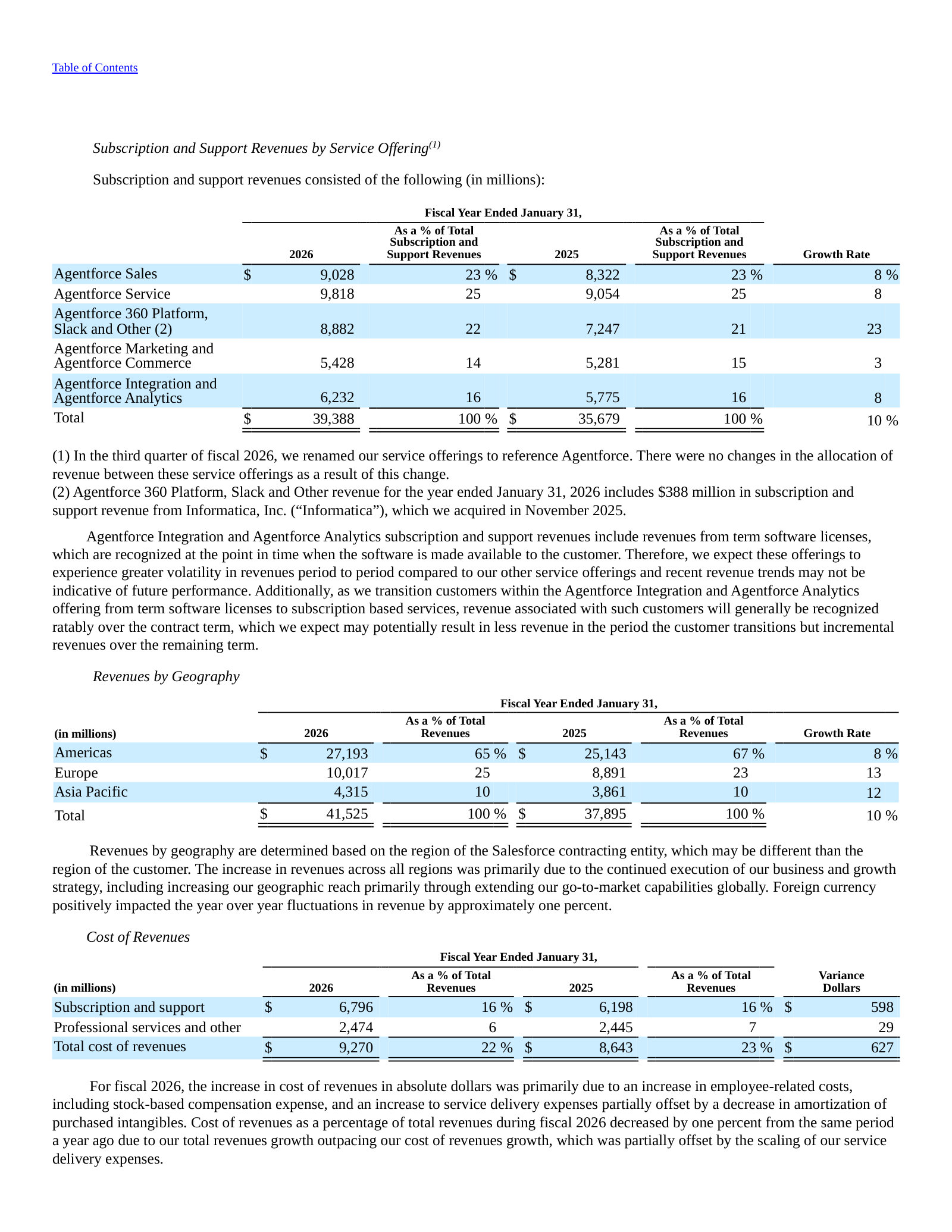
We operate as one segment. […] We derive our revenues from two sources: (1) subscription and support revenues and (2) professional services and other revenues. Subscription and support revenues accounted for approximately 95 percent of our total revenues for fiscal 2026.
p. 54 · Read in context →
Item 7. MD&A — Results of Operations — p. 61 · Read the full section →
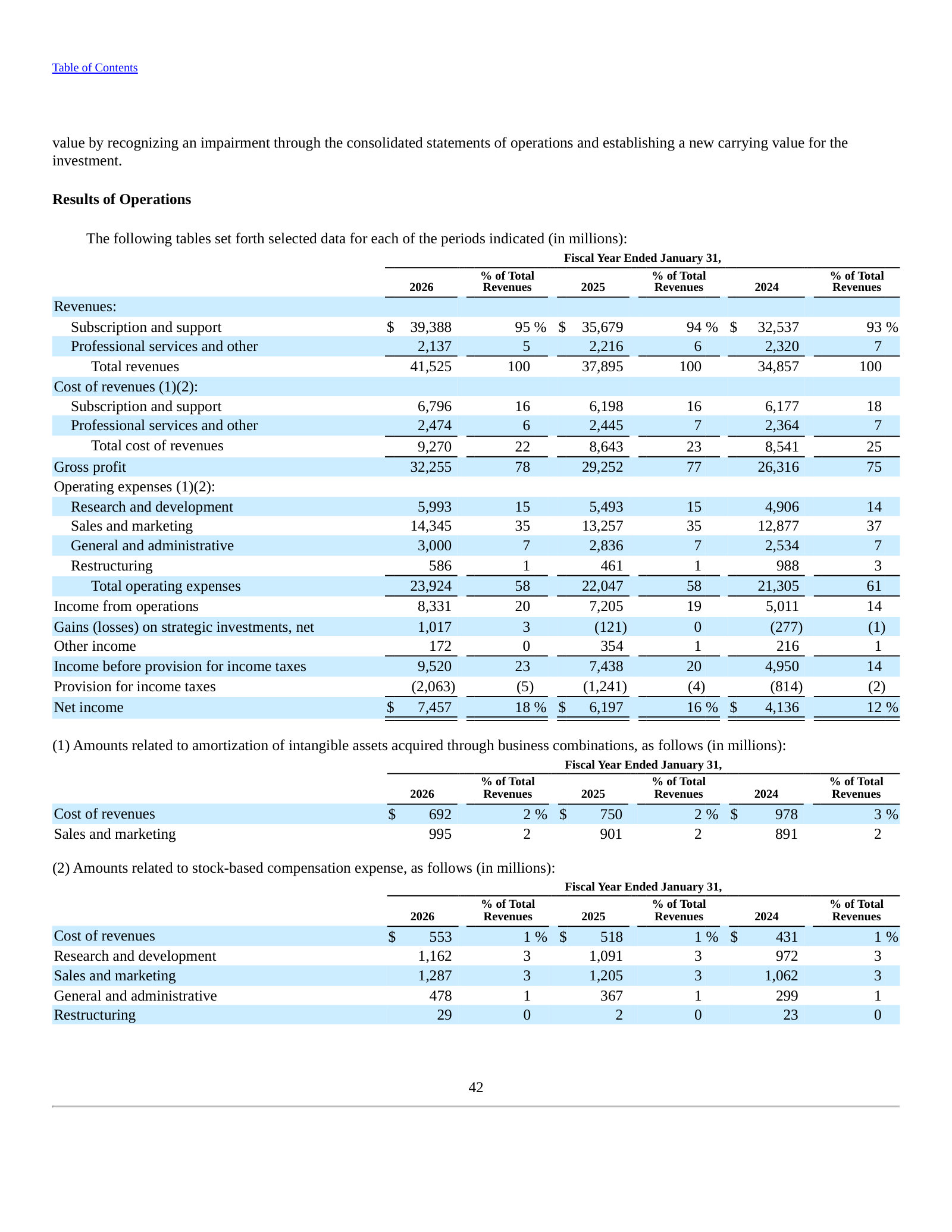
Where management explains what drove results — margins, opex, and the newly Agentforce-branded revenue mix.
Item 7. MD&A — Cash Flows — p. 68 · Read the full section →
The cash engine behind the P&L: operating cash flow and what it converts from.
Operating cash flow of ~$15.0B: $7.5B net income plus D&A and stock-based compensation.
The net cash provided by operating activities during fiscal 2026 was primarily comprised of net income of $7.5 billion, adjusted for non-cash items, including $3.6 billion of depreciation and amortization and $3.5 billion of stock-based compensation expense.
p. 68 · Read in context →
Salesforce, Inc. — FY2023 Annual Report (Form 10-K, fiscal year ended January 31, 2023) — FY2023
Included to show the pre-Agentforce identity: 'Customer 360' and Slack as 'digital headquarters,' with revenue named by function, not AI agent. · Open the full document →
Item 1. Business — Overview — p. 6 · Read the full section →
Two years before the rebrand, the self-description centered on 'Customer 360' and Slack — with no AI-agent framing.
FY2023 identity: 'Customer 360' unifying teams and Slack as a 'digital headquarters.'
Our Customer 360 platform unites sales, service, marketing, commerce and IT teams by connecting customer data across systems, apps and devices to create a complete view of customers. […] With Slack, we provide a digital headquarters where companies, employees, governments and stakeholders can collaborate to create success from anywhere.
p. 6 · Read in context →
Item 7. MD&A — Subscription Revenues by Service Offering — p. 47 · Read the full section →
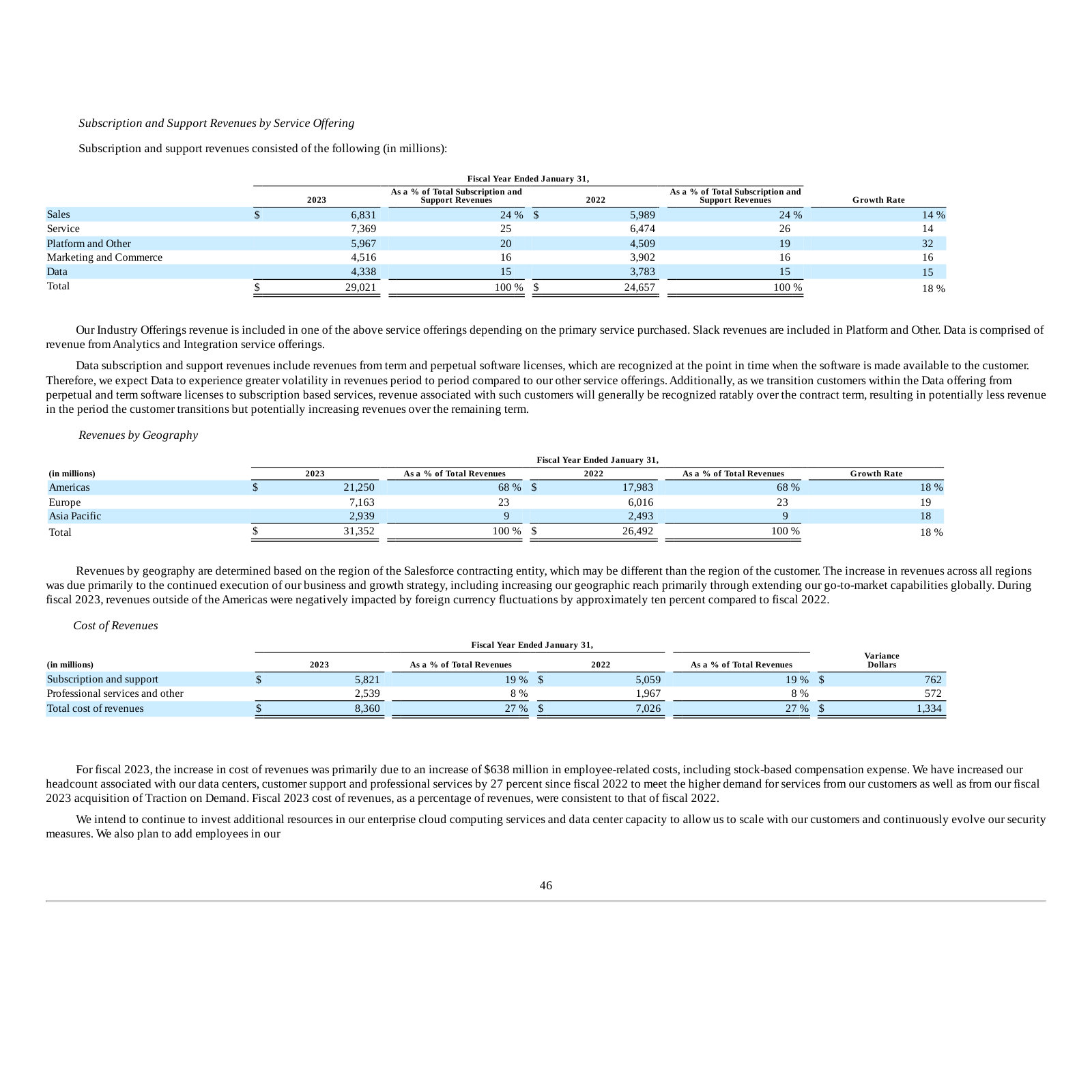
The revenue taxonomy before FY2026: clouds named by function (Sales, Service, Platform, Marketing & Commerce, Data).
More annual reports
Salesforce, Inc. — FY2025 Annual Report (Form 10-K, fiscal year ended January 31, 2025) — FY2025 · 138 pages · The Einstein 1 / Data Cloud year immediately before the Agentforce rebrand; useful for tracing the AI pivot. · Open →
Salesforce, Inc. — FY2024 Annual Report (Form 10-K, fiscal year ended January 31, 2024) — FY2024 · 142 pages · The margin-inflection and 'Restructuring' year, when Salesforce pivoted hard toward profitability. · Open →